The Gods & the Eddas
The Seeress's Prophecy
The dead seeress speaks
If Hávamál is the wisdom of the Norse world and Gylfaginning its prose handbook, Völuspá — 'the Seeress's Prophecy' — is its poetry: a single sweeping vision, the grandest poem the North produced, that holds the whole history of the cosmos from its first making to its end and rebirth. It is spoken by a völva, an ancient seeress, whom Odin has raised — perhaps from the dead — to compel her secret knowledge.[1]
She begins by calling for silence from all the worlds and declaring that she remembers things older than anything living: the giants who bore her in the dawn of time. This is the framing that gives the poem its uncanny authority — it is not a god explaining the world from outside, but a being older than the gods themselves, recounting what she has seen, in the present tense of prophecy. Gylfaginning told this same cosmos as a question-and-answer; Völuspá sings it as a vision. They are the prose and the verse of one mythology, and this poem is the source much of the other draws on.
The source text · 1
Hearing I ask / from the holy races, / From Heimdall's sons, / both high and low; / Thou wilt, Valfather, / that well I relate / Old tales I remember / of men long ago.— voluspo
The Seeress calls for silence and offers to recite the ancient lore at Odin's will (Bellows 1923).
Before the world
The Seeress's vision opens before the beginning. She remembers the age when Ymir lived, when there was neither sea nor cool waves nor sand, no earth and no heaven above — only the yawning gap, and grass nowhere.[1] Out of that emptiness the gods raised the lands, set the sun and moon and stars in their courses, and ordered time itself.
This is the same creation Gylfaginning lays out in prose — the void, the first giant, the world built up by the gods — but compressed here into a few stanzas of tremendous power, the cosmos called into being in a handful of lines. The poem then tells of a golden age: the gods at play with their game-pieces of gold, glad and untroubled, lacking nothing — until that peace is broken, and the first war and the first killings enter the world. From the very start the Norse cosmos carries the seed of its own undoing; even the gods' golden morning does not last.
The source text · 1
Of old was the age / when Ymir lived; / Sea nor cool waves / nor sand there were; / Earth had not been, / nor heaven above, / But a yawning gap, / and grass nowhere.— voluspo
Of old was the age when Ymir lived; no earth, no heaven, the yawning void (Bellows 1923).
The World-Ash and the Norns
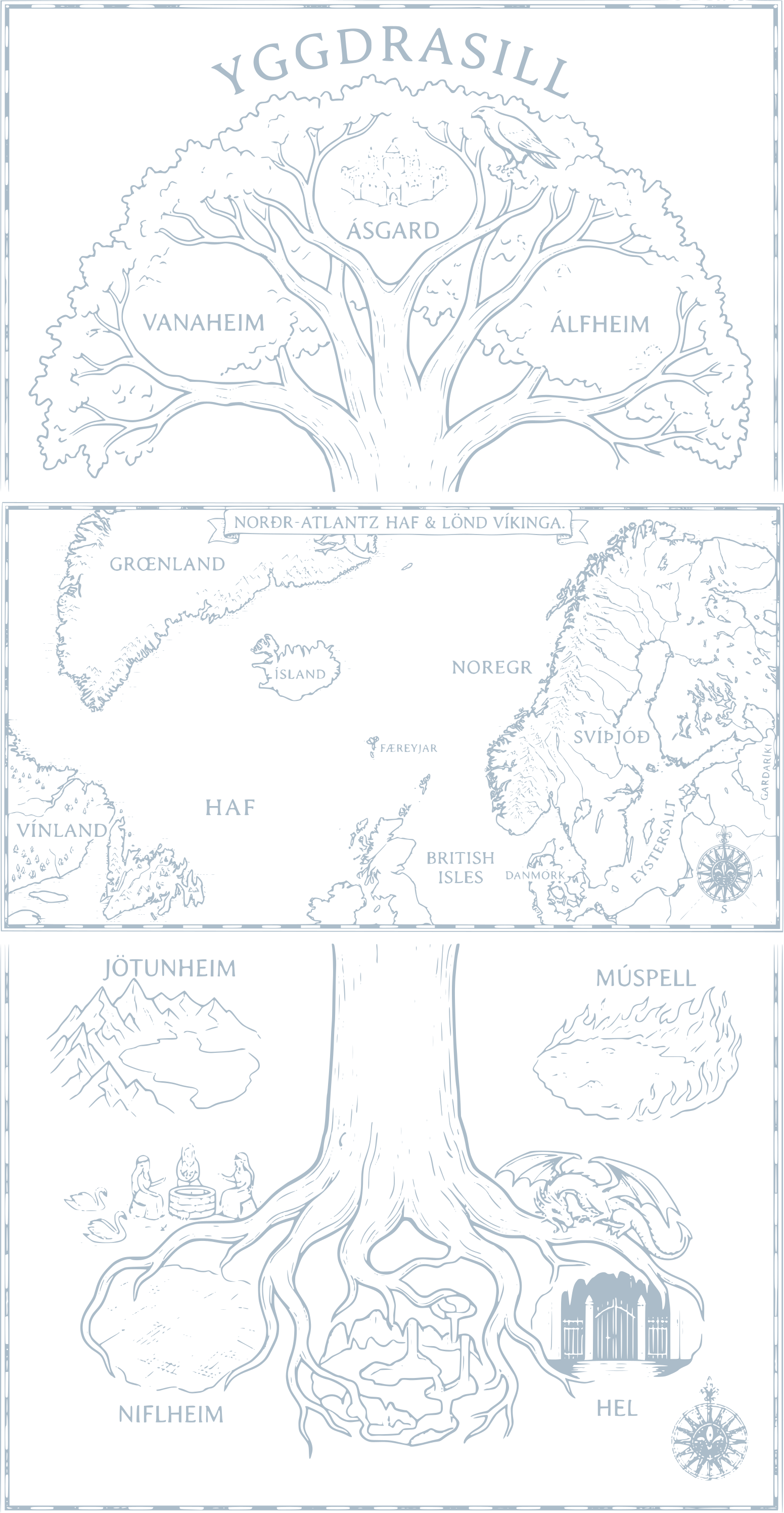
At the centre of her vision, as at the centre of the whole mythology, stands Yggdrasil — the Ash she knows by name, the great tree wet with white water, from which the dews fall into the dales, standing ever green over the Well of Urd.[1] And there she sees the Norns, the maidens deep in knowledge who come from the well to set the laws and choose the lives of the children of men — to carve men's fates.
This is the deep architecture of the Norse world: a living tree holding the cosmos together, and beneath it the three weird-sisters who fix destiny for gods and mortals alike. It is the root of the fatalism that runs through every saga in this atlas — the sense that a life is already shaped, that a man's ørlǫg is laid down before he acts, and that wisdom lies in meeting an appointed fate well rather than escaping it. The Seeress does not merely describe the Norns; she speaks as one who sees the whole woven pattern, beginning to end, which is why what she says next can be prophecy.
The source text · 1
An ash I know, / Yggdrasil its name, / With water white / is the great tree wet; / Thence come the dews / that fall in the dales, / Green by Urth's well / does it ever grow.— voluspo
Yggdrasil the Ash, wet with white water, ever green over the well; the Norns (Bellows 1923).
The death of Baldr and the breaking of bonds
The vision darkens toward the end. The Seeress foresees the death of Baldr, the bright and bleeding god — the killing that, in the fuller telling of Gylfaginning, Loki contrives through the blind god and the mistletoe, and that no tears can ransom back from Hel.[1] Baldr's death is the hinge: with the best of the gods gone into the dark, the world tips toward its doom.
Then come the signs of the unbinding. She sees Loki the betrayer, who lies bound for his crimes, and the monsters straining at their fetters; she sees brothers who will fight and slay each other, kinship stained with kin-blood, an axe-age and a sword-age before the world falls — wind-age, wolf-age, where no man will spare another.[2] This is the Norse vision of the last days: not a sudden catastrophe but a moral collapse, the bonds of kinship and oath dissolving, the very thing the sagas and Hávamál hold most sacred coming undone. The end of the world begins as the end of trust between people.
The source text · 2
I saw for Baldr, / the bleeding god, / The son of Othin, / his destiny set: / / Famous and fair / in the lofty fields, / Full grown in strength / the mistletoe stood.— voluspo
the Seeress foresees the bleeding god Baldr's death (Bellows 1923).
Brothers shall fight / and fell each other, / And sisters' sons / shall kinship stain; / / Hard is it on earth, / with mighty whoredom; / Axe-time, sword-time, / shields are sundered, / Wind-time, wolf-time, / ere the world falls; / Nor ever shall men / each other spare.— voluspo
brothers shall fight and fell each other; axe-age, sword-age before the world falls (Bellows 1923).
Ragnarök
Then the end itself, in the poem's most famous and most terrible stanzas. Ragnarök comes: the gods and their monstrous enemies meet in the last battle, Odin falls to the Wolf, the fire-giant Surtr's flame sweeps the world — and the Seeress sees the cosmos itself dissolve. The sun turns black, earth sinks in the sea, the hot stars down from heaven are whirled.[1] Fire rages against the sky; the whole created order, raised in stanza three, is unmade.
It is the bleakest vision in Norse literature, and the most unflinching: the gods themselves die, knowingly, and the world they made burns and drowns. This is the dark heart of the whole atlas — the doom that the saga-heroes' fatalism echoes in the human key. Every fey man walking to his death, every hero who meets his end with a hard word and no flinching, is living out in miniature what the Seeress sees the gods themselves endure. In this mythology, courage is not the hope of victory; it is the refusal to be diminished by a defeat you know is coming. The gods face the black sun, and so their people learn to face their own.
The source text · 1
The sun turns black, / earth sinks in the sea, / The hot stars down / from heaven are whirled; / Fierce grows the steam / and the life-feeding flame, / Till fire leaps high / about heaven itself.— voluspo
The sun turns black, earth sinks in the sea, the stars whirled from heaven (Bellows 1923).
The green world rising
And then — the turn that makes Völuspá unlike almost any apocalypse ever sung. The Seeress's vision does not end in fire and silence. Now do I see the earth anew rise all green from the waves again; the waters fall, the eagle flies over them, and a cleansed world comes up out of the sea.[1] The surviving gods return and gather on the old field; Baldr comes back from the dead; and the gods find again in the grass the golden game-pieces they had played with in the morning of the world, before everything fell.
It is a vision of renewal after total destruction — not a restoration of the old world but the birth of a new and innocent one, with the slate washed clean. The poem closes on a last, ambiguous image: the dark dragon Niðhöggr flying up from below, bearing corpses on his wings[2] — a shadow at the edge of the new dawn, as if to say no order is ever wholly free of the old darkness. That is the final note of the Norse mythology, and it is characteristically clear-eyed: the world ends, and the world begins again, and even in the green new morning the dragon is still somewhere in the sky. Hope and shadow together, which is exactly how the sagas see life itself.
The source text · 2
Now do I see / the earth anew / Rise all green / from the waves again; / The cataracts fall, / and the eagle flies, / And fish he catches / beneath the cliffs.— voluspo
Now do I see the earth anew rise all green from the waves again (Bellows 1923).
From below the dragon / dark comes forth, / Nithhogg flying / from Nithafjoll; / The bodies of men / on his wings he bears, / The serpent bright: / but now must I sink.— voluspo
the dragon Nithhogg comes from below bearing corpses — the vision's last ambiguous image (Bellows 1923).
4 connection questions mark the end of this journey — and earn its keepable artifact.
More journeys → Follow a thread →