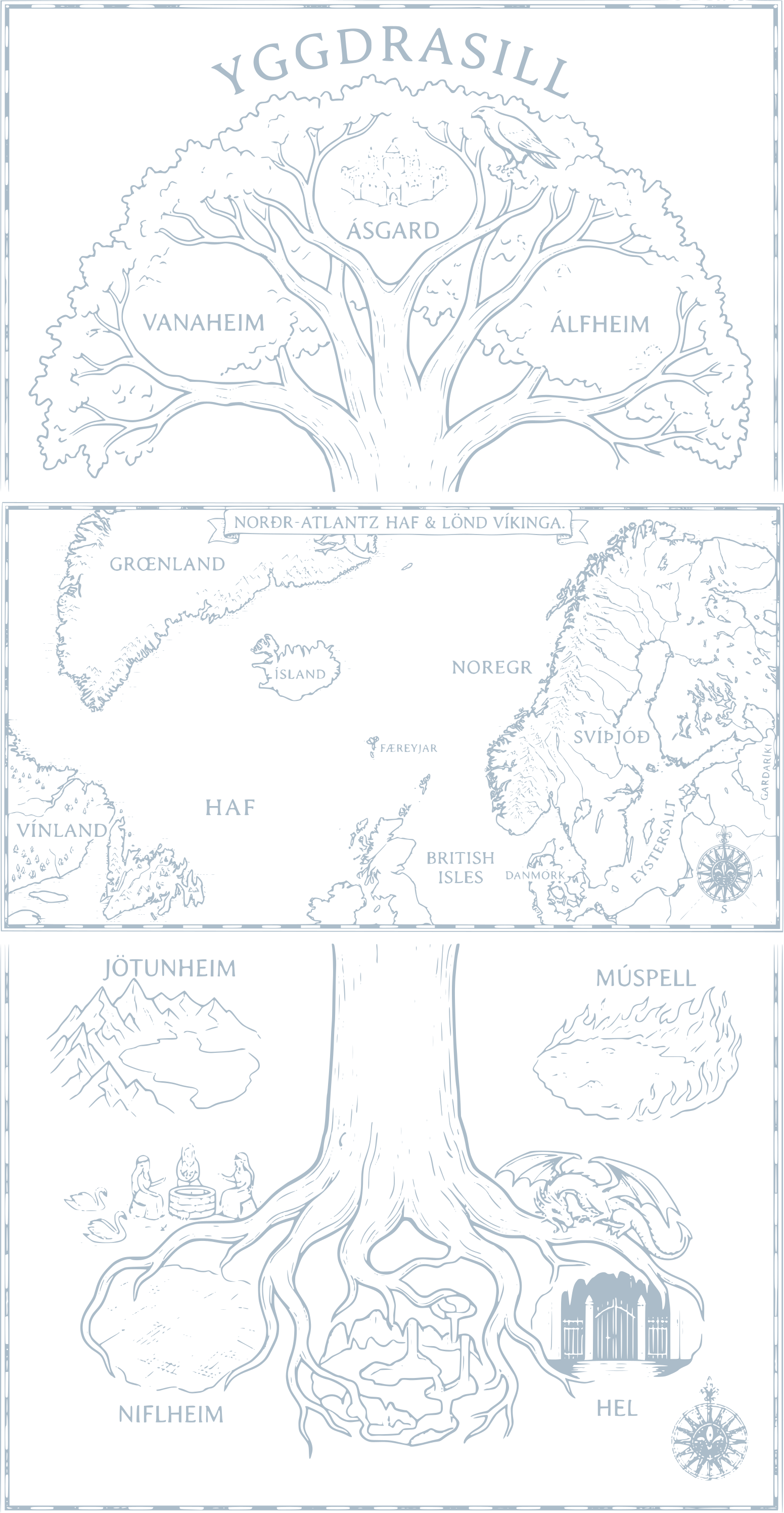
← Journeys

The Kings of Norway

Olaf Tryggvason — the King from the East

Before he was the warrior-king who dragged Norway to the new faith, Olaf Tryggvason was a hunted infant, a slave sold in a Baltic market, and a boy raised at the court of the Rus on the river-road east. Heimskringla follows him from that captivity in Garðaríki back across the sea to the throne — the forced conversion of Norway and the colonies, the great ship Long Serpent, and the ambush at Svolder where he leapt into the sea rather than be taken. The most dazzling and tragic of the kings, whose road ran from Holmgard to the bottom of the Baltic.
1

Born in flight

The saga of Olaf Tryggvason opens not with a king but with a fugitive. His father, King Tryggve, had been murdered; his mother Astrid, pregnant, fled with what loose property she could carry and hid on a holm in a lake, where she bore her son.[1] From his first breath Olaf was a marked child — heir to a killed king, hunted by the vengeful queen Gunnhild, who sent armed troops ranging the Uplands and Viken to find the boy and end the line.[2]

So the future Christianiser of the North begins as the most vulnerable thing in the saga world: a king's child with no kingdom, kept alive only by his mother's flight and the loyalty of a few followers. Everything grand that follows — the fleet, the faith, the famous ship — grows from this small hunted beginning, and the saga never lets us forget how far he had to come.

The source text · 2
[1] Ástríðr
King Tryggve Olafsson had married a wife who was called Astrid. She was a daughter of Eric Biodaskalde, a great man, who dwelt at Ofrostad. But after Tryggve's death Astrid fled, and privately took with her all the loose property she could. Her foster-father, Thoralf Lusiskiseg, followed her, and never left her; and others of her faithful followers spied about to discover her enemies, and where they were. Astrid was pregnant with a child of King Tryggve, and she went to a lake, and concealed herself in a holm or small island in it with a few men. Here her child was born, and it was a boy; and water was poured over it, and it was called Olaf after the grandfather. Astrid remained all summer here in concealment; but when the nights became dark, and the day began to shorten and the weather to be cold, she was obliged to take to the land, along with Thoralf and a few other men. They did not seek for houses, unless in the night time, when they came to them secretly; and they spoke to nobody. One evening, towards dark, they came to Ofrostad, where Astrid's father Eric dwelt, and privately sent a man to Eric to tell him; and Eric took them to an out-house, and spread a table for them with the best of food. When Astrid had been here a short time her travelling attendants left her, and ​none remained behind with her but two servant girls, her child Olaf, Thoralf Lusiskiæg, and his son Thorgils, who was six years old; and they remained all winter.— heimskringla

Astrid flees after Tryggve's murder and bears Olaf in hiding (Laing).

[2] Óláfr Tryggvason
The spring after Gunhild sent spies to the Uplands, and all the way down to Viken, to spy what they could about Astrid; and her men came back, and could only tell her that Astrid must be with her father Eric, and it was probable was bringing up her infant, the son of Tryggve. Then Gunhild, without delay, sent off men well furnished with arms and horses, and in all a troop of thirty; and as their leader she sent a particular friend of her own, a powerful man called Hakon. Her orders were to go to Ofrostad to Eric, and take King Tryggve's son from thence, and bring the child to her; and with these orders the men went out. Now when they were come to the neighbourhood of Ofrostad, some of Eric's friends observed the troop of travellers, and about the close of the day brought him word of their approach. Eric immediately, in the night, made preparation for Astrid's flight, gave her good guides, and sent her away eastward to Sweden, to his good friend Hakon Gamle, who was a powerful man there. ​Long before day they departed, and towards evening they reached a domain called Skon. Here they saw a large mansion, towards which they went, and begged a night's lodging. For the sake of concealment they were clad in mean clothing. There dwelt here a bonder called Biorn Edderquise, who was very rich, but very inhospitable. He drove them away; and therefore, towards dark, they went to another domain close by that was called Yither. . Thorstein was the name of the bonder; and he gave them lodging, and took good care of them, so that they slept well, and were well entertained. Early that morning Gunhild's men had come to Ofrostad, and inquired for Astrid and her son. As Eric told them she was not there, they searched the whole house, and remained till late in the day before they got any news of Astrid. Then they rode after her the way she had taken, and late at night they came to Biorn Edderquise in Skon, and took up their quarters there. Hakon asked Biorn if he knew any thing about Astrid, and he said some people had been there in the evening wanting lodgings; "but I drove them away, and I suppose they have gone to some of the neighbouring houses." Thorstein's labourer was coming from the forest, having left his work at nightfall, and called in at Biorn's house because it was in his way; and finding there were guests come to the house, and learning their business, he comes to Thorstein and tells him of it. As about a third part of the night was still remaining, Thorstein wakens his guests, and orders them in an angry voice to go about their business; but as soon as they were out of the house upon the road, Thorstein tells them that Gunhild's messengers were at Biorn's house, and are upon the trace of them. They entreat of him to help them, and he gave them a guide and some provisions. He conducted them through the forest to a lake, in which ​there was an islet overgrown with reeds. They waded out to the islet, and hid themselves among the reeds. Early in the morning Hakon rode away from Biorn7s into the township, and wherever he came he asked after Astrid; and when he came to Thorsteins he asked if she had been there. He said that some people had been there; but as soon as it was daylight they had set off again, eastwards, to the forest. Hakon made Thorstein go along with them, as he knew all the roads and hiding-places. Thorstein went with them; but when they were come into the woods, he led them right across the way Astrid had taken. They went about and about the whole day to no purpose, as they could find no trace of her; so they turned back to tell Gunhild the end of their travel. Astrid and her friends proceeded on their journey, and came to Sweden, to Hakon Gamle (the Old), where she and her son remained a long time, and had friendly welcome.— heimskringla

Gunnhild sends armed men to hunt the infant Olaf.

2

Taken on the Baltic

Astrid had a brother, Sigurd, who had gone east years before and risen high in Russia — in Garðaríki, the land of the Rus — in the service of King Valdemar.[1] When Astrid resolved to take her boy to that safe and distant court, she set out east across the Baltic with merchants. But the sea-road east was a viking road too: off the coast they were taken by raiders of Esthonia, who made booty of the people aboard and split them up. The three-year-old Olaf was carried off into slavery.[2]

Here is the first turn of the Austrvegr, the road east, that runs through the whole corpus: the same river-and-sea highway that carried Norse traders to riches carried this royal child into bondage. The boy who would command the greatest ship in the North was, for a span of years, a thrall passed from hand to hand on a foreign shore — sold, the saga says, for a good cloak.

The source text · 2
[1] Sigurðr Eiríksson
Astrid had a brother called Sigurd, a son of Eric Biodaskalde, who had long been abroad in Russia with King Yaldemar, and was there in great consideration. Astrid had now a great inclination to travel to her brother there. Hakon the Old gave her good attendants, and what was needful for the journey, and she set out with some merchants. She had then been two years with Hakon the Old, and Olaf was three years of age. As they sailed out into the Baltic, they were captured by vikings of Esthonia, who made booty both of the people and goods, killing some, and dividing others as slaves. Olaf was separated from his mother, and an Esthonian man called Klerkon got him as his share along with Thoralf and Thorkils. Klerkon thought that Thoralf was too old for a slave, and that there was not much work to be got out of him, so he killed him; but took the boys with him, and sold them to a man called Klierk for a stout and good ram. A third man, called Reas, bought Olaf for a good cloak. Reas had a wife called Rekon, and a son by her whose name was Rekoni. Olaf was long with them, was treated well, and was much beloved by the people. Olaf was six years in Esthonia in this banishment.— heimskringla

Sigurd long in Russia with King Valdemar, in great consideration (Laing).

[2] Olaf sold into slavery in the east
Astrid had a brother called Sigurd, a son of Eric Biodaskalde, who had long been abroad in Russia with King Yaldemar, and was there in great consideration. Astrid had now a great inclination to travel to her brother there. Hakon the Old gave her good attendants, and what was needful for the journey, and she set out with some merchants. She had then been two years with Hakon the Old, and Olaf was three years of age. As they sailed out into the Baltic, they were captured by vikings of Esthonia, who made booty both of the people and goods, killing some, and dividing others as slaves. Olaf was separated from his mother, and an Esthonian man called Klerkon got him as his share along with Thoralf and Thorkils. Klerkon thought that Thoralf was too old for a slave, and that there was not much work to be got out of him, so he killed him; but took the boys with him, and sold them to a man called Klierk for a stout and good ram. A third man, called Reas, bought Olaf for a good cloak. Reas had a wife called Rekon, and a son by her whose name was Rekoni. Olaf was long with them, was treated well, and was much beloved by the people. Olaf was six years in Esthonia in this banishment.— heimskringla

Astrid's ship taken by Esthonian vikings; Olaf carried off.

3

Ransomed in the slave-market

Years later, his uncle Sigurd came into Esthonia out of Holmgard — Novgorod — on King Valdemar's business, to collect the king's taxes, travelling as a great man with a magnificent following.[1] In the market-place his eye fell on a remarkably handsome boy who was plainly a foreigner. He asked the child his name and family, and the boy answered that he was Olaf, son of Tryggve Olafsson, and that Astrid, daughter of Eric, was his mother.

So uncle and nephew met by chance across a slave-market, and Sigurd bought the boy's freedom and his foster-brother's, and brought them home with him to Holmgard.[2] It is one of the saga's quiet miracles of fate: the whole future of Norway's faith turned on a tax-collector recognising a face in a foreign crowd. The captive prince was free, and he was now a child of the eastern court — the road east had given him back.

The source text · 2
[1] Hólmgarðr (Novgorod)
Sigurd, the son of Eric (Astrid's brother), came into Esthonia from Hovogorod, on King Yaldemar's business to collect the king's taxes and rents. Sigurd came as a man of consequence, with many followers and great magnificence. In the market-place he happened to observe a remarkably handsome boy; and as he could distinguish that he was a foreigner, he asked him his name and family. He answered him, that his name was Olaf; that he was a son of Tryggve Olafsson; and Astrid, a daughter of Eric Biodaskalde, was his mother. Then Sigurd knew that the boy was his sister's son, and asked him how he came there. Olaf told him minutely all his adventures, and Sigurd told him to follow him to the peasant Beas'. When he came there he bought both the boys, Olaf and Thorgils, and took them with him to Novogorod. But, for the first, he made nothing known of Olaf's relationship to him, but treated him well.— heimskringla

Sigurd comes into Esthonia from Holmgard on King Valdemar's tax business (Laing).

[2] Valdimarr (Vladimir)
Sigurd, the son of Eric (Astrid's brother), came into Esthonia from Hovogorod, on King Yaldemar's business to collect the king's taxes and rents. Sigurd came as a man of consequence, with many followers and great magnificence. In the market-place he happened to observe a remarkably handsome boy; and as he could distinguish that he was a foreigner, he asked him his name and family. He answered him, that his name was Olaf; that he was a son of Tryggve Olafsson; and Astrid, a daughter of Eric Biodaskalde, was his mother. Then Sigurd knew that the boy was his sister's son, and asked him how he came there. Olaf told him minutely all his adventures, and Sigurd told him to follow him to the peasant Beas'. When he came there he bought both the boys, Olaf and Thorgils, and took them with him to Novogorod. But, for the first, he made nothing known of Olaf's relationship to him, but treated him well.— heimskringla

Sigurd recognises and ransoms his nephew Olaf in the marketplace.

4

The boy who took his own vengeance

Olaf grew up at the eastern court, but the saga marks his temper early. One day in the market-place of Holmgard he recognised Klerkon, the very viking who had killed his beloved foster-father Thoralf when the ship was taken. Olaf had a little axe in his hand. He clove Klerkon's skull to the brain and ran home to tell Sigurd what he had done.[1]

By the law of Garðaríki a killing within the town demanded the slayer's life, and a mob gathered. But Sigurd rushed the boy to Queen Allogia and begged her protection; she judged the child far too comely to be killed, took him under her wing, and paid the blood-fine herself.[2] Already we see the man entire: the swift, total vengeance, the readiness to kill with whatever is in his hand, and the charisma that makes the powerful shelter him. The boy avenged his foster-father at the heart of a foreign kingdom and walked away protected.

The source text · 2
[1] Óláfr Tryggvason
Olaf Tryggvesson was one day in the market-place, where there was a great number of people. He recognised Klasrkon again, who had killed his foster-father Thoralf Lusiskiseg. Olaf had a little axe in his hand, and with it he clove Klærkon's scull down to the brain, and ran home to his lodging, and told his friend Sigurd what he had done. Sigurd immediately took Olaf to Queen Allogia's house, told her what had happened, and begged her to protect the boy. She replied, that the boy appeared far too comely to allow him to be slain; and she ordered her people to be drawn out fully armed. In Novogorod, the sacredness of peace is so respected, that it is law there to slay whoever puts a man to death except by judgment of law; and, according to this law and usage, the whole people stormed and sought after the boy. It was reported that he was in the queen's House, and that there was a number of armed men there. When this was told to the king, he went there with his ​people, but would allow no bloodshed. It was settled at last in peace, that the king should name the line for the murder; and the queen paid it. Olaf remained afterwards with the queen, and was much beloved. It is a law at Novogorod, that no man of a royal descent shall stay there without the king's permission. Sigurd therefore told the queen of what family Olaf was, and for what reason he had come to Russia; namely, that he could not remain with safety in his own country: and begged her to speak to the king about it. She did so, and begged the king to help a king's son whose fate had been so hard; and in consequence of her entreaty the king promised to assist him, and accordingly he received Olaf into his court, and treated him nobly, and as a king's son. Olaf was nine years old when he came to Russia, and he remained nine years more with king Yaldemar. Olaf was the handsomest of men, very stout and strong, and in all bodily exercises he excelled every Northman that ever was heard of. .— heimskringla

Olaf kills Klerkon with a little axe to avenge his foster-father (Laing).

[2] Allogia
Olaf Tryggvesson was one day in the market-place, where there was a great number of people. He recognised Klasrkon again, who had killed his foster-father Thoralf Lusiskiseg. Olaf had a little axe in his hand, and with it he clove Klærkon's scull down to the brain, and ran home to his lodging, and told his friend Sigurd what he had done. Sigurd immediately took Olaf to Queen Allogia's house, told her what had happened, and begged her to protect the boy. She replied, that the boy appeared far too comely to allow him to be slain; and she ordered her people to be drawn out fully armed. In Novogorod, the sacredness of peace is so respected, that it is law there to slay whoever puts a man to death except by judgment of law; and, according to this law and usage, the whole people stormed and sought after the boy. It was reported that he was in the queen's House, and that there was a number of armed men there. When this was told to the king, he went there with his ​people, but would allow no bloodshed. It was settled at last in peace, that the king should name the line for the murder; and the queen paid it. Olaf remained afterwards with the queen, and was much beloved. It is a law at Novogorod, that no man of a royal descent shall stay there without the king's permission. Sigurd therefore told the queen of what family Olaf was, and for what reason he had come to Russia; namely, that he could not remain with safety in his own country: and begged her to speak to the king about it. She did so, and begged the king to help a king's son whose fate had been so hard; and in consequence of her entreaty the king promised to assist him, and accordingly he received Olaf into his court, and treated him nobly, and as a king's son. Olaf was nine years old when he came to Russia, and he remained nine years more with king Yaldemar. Olaf was the handsomest of men, very stout and strong, and in all bodily exercises he excelled every Northman that ever was heard of. .— heimskringla

Queen Allogia shelters the boy and pays for the killing.

5

The harrying viking

From the eastern court the saga sends Olaf out onto the open sea as a viking, and he becomes one of the great harriers of the age — raiding the Baltic and the western lands, fighting in Wendland and the British Isles, winning fame and following.[1] He was, the saga says, more expert in every bodily feat than any man in Norway whose memory is preserved — he could walk the oars outboard while his men rowed, juggle three knives, throw two spears at once.[2]

This is the Olaf the West remembers as a scourge: the brilliant, restless raider with no kingdom, carving a name out of plunder. But the wandering had a shape he did not yet see. The same voyages that made him a feared viking were carrying him, port by port, toward the encounter that would turn the raider into a missionary-king — and toward the Norway his father had lost.

The source text · 2
[1] Óláfr Tryggvason
The spring after King Olaf fitted out and manned his ships, and commanded himself his ship the Crane. He had many and smart people with him; and when hew as ready, he sailed northwards with his fleet past. Byrd Isle, and to Halogaland. Wheresoever he came to the land, or to the islands, he held a Thing, and told the people to accept the right faith, and to be baptized. No man dared to say any thing against it, and the whole country he passed through was made Christian. King Olaf was a guest in the house of Harek of Thiottö, who was baptized with all his people. At parting the king gave Harek good presents; and he entered into the king's service, and got fiefs, and the privileges of lendsman from the king.— heimskringla

Olaf fits out his fleet and ranges the coast (Laing).

[2] Óláfr Tryggvason
King Olaf was more expert in all exercises than any man in Norway whose memory is preserved to us in sagas; and he was stronger and more agile than most men, and many stories are written down about it. One is, that he ascended the Smalsor Horn[54], and fixed his shield upon the very peak. Another is, that one of his followers had climbed up the peak after him, until he came to where he could neither get up nor down; but the king came to his help, climbed up to him, took him under his arm, and bore him to the flat ground. King Olaf could run across the oars outside of the vessel while his men were rowing the Serpent. He could play with three daggers, so that one was always in the air, and he took the one falling by the handle. He could walk all round upon the ​ship's rails, could strike and cut equally well with both hands, and could cast two spears at once. King Olaf was a very merry frolicsome man; gay and social; had great taste in every thing; was very generous; was very finical in his dress, but in battle he exceeded all in bravery. He was distinguished for cruelty when he was enraged, and tortured many of his enemies. Some he burnt in fire; some he had torn in pieces by mad dogs; some he had mutilated, or cast down from high precipices. On this account his friends were attached to him warmly, and his enemies feared him greatly; and thus he made such a fortunate advance in his undertakings, for some obeyed his will out of the friendliest zeal, and others out of dread.— heimskringla

Olaf the most expert man in all bodily feats in Norway.

6

Baptised in the western sea

It was far out in the western isles, the saga tells, that Olaf turned. Among the Scillies he met a hermit-seer who foretold his future and his greatness, and Olaf, moved and convinced, took baptism there — the raider become a Christian at the edge of the world.[1]

From that moment his enormous energy had a single object. He would not merely be a Christian; he would make the whole North Christian, and he would do it with the same force he had brought to raiding. He sailed for Norway to claim his father's throne, and the country, weary of Earl Hakon, took him gladly. The hunted infant, the eastern slave, the western viking was now King of Norway — and a man with a mission that would reach every saga in this atlas.

The source text · 1
[1] The conversion of Norway
The spring after King Olaf fitted out and manned his ships, and commanded himself his ship the Crane. He had many and smart people with him; and when hew as ready, he sailed northwards with his fleet past. Byrd Isle, and to Halogaland. Wheresoever he came to the land, or to the islands, he held a Thing, and told the people to accept the right faith, and to be baptized. No man dared to say any thing against it, and the whole country he passed through was made Christian. King Olaf was a guest in the house of Harek of Thiottö, who was baptized with all his people. At parting the king gave Harek good presents; and he entered into the king's service, and got fiefs, and the privileges of lendsman from the king.— heimskringla

Olaf, now Christian, begins to press the faith on the land (Laing).

7

Norway by the sword

Olaf converted Norway with a thoroughness that brooked no refusal. Wherever he came — to the mainland, to the islands — he held a Thing and bade the people accept the faith and be baptised; and where persuasion failed he used the sword, the torture, the threat.[1] The man Raud, who would not yield, he had put to a hideous death; the chiefs who resisted he broke. District by district, by reason and by terror, the old gods were driven out of Norway.

The saga does not soften this. Olaf's faith is real and his methods are brutal, and Heimskringla holds both at once. To the family sagas of Iceland, this is the pressure coming from across the sea — the king whose decree that all his realm and dependencies must be Christian would, within a few years, reach the Althing itself and force the greatest decision in Iceland's history.

The source text · 1
[1] Óláfr Tryggvason
The spring after King Olaf fitted out and manned his ships, and commanded himself his ship the Crane. He had many and smart people with him; and when hew as ready, he sailed northwards with his fleet past. Byrd Isle, and to Halogaland. Wheresoever he came to the land, or to the islands, he held a Thing, and told the people to accept the right faith, and to be baptized. No man dared to say any thing against it, and the whole country he passed through was made Christian. King Olaf was a guest in the house of Harek of Thiottö, who was baptized with all his people. At parting the king gave Harek good presents; and he entered into the king's service, and got fiefs, and the privileges of lendsman from the king.— heimskringla

Olaf holds Things and compels baptism throughout the land (Laing).

8

Kjartan and Hallfred — the saga heroes at his court

Now the king begins to appear inside the family sagas, for the Icelanders came to his court and met the new faith in his hall. Kjartan Olafsson — grandson of Egil, hero of Laxdæla — came from Iceland and so impressed the king that, after a famous swimming-match between them, Olaf brought him to Christianity and sent him home baptised in his white robes.[1]

The poet Hallfred, called 'the Troublesome Skald', would take baptism only on the condition that the king himself stand as his godfather — and Olaf agreed and held him at the font.[2] These are not footnotes: they are the seams where Heimskringla and the Icelandic sagas are sewn together. The same Olaf who is a chapter of Norwegian history is a living character in Laxdæla and in the skalds' own sagas — the royal hinge between the kingdoms.

The source text · 2
[1] Óláfr Tryggvason
handsome man, and of ready and agreeable speech. After the king and Kiartan had conversed a little, the king asked him to adopt Christianity. Kiartan replies, that he would not say no to that, if he thereby obtained the king's friendship; and as the king promised him the fullest friendship, they were soon agreed. The next day Kiartan was baptized, together with his relation Bolle Thorleikson, and all their fellow-travellers. Kiartan and Bolle were the king's guests as long as they were in their white baptismal clothes, and the king had much kindness for them. Wherever they came they were looked upon as people of distinction.— heimskringla

Kjartan baptised at Olaf's court (Laing); links to Laxdæla.

[2] Óláfr Tryggvason
The king replies, "That I will do." And Halfred was baptized, the king holding him during the baptism.— heimskringla

Hallfred baptised with the king as godfather.

9

Leif and the road to Vínland

And then the widest seam of all. Leif Eriksson, son of Eric the Red of Greenland, came to Norway, met King Olaf, and adopted Christianity, passing the winter with him.[1] In the spring the king sent Leif back to Greenland charged with proclaiming the faith there — and it was on that very voyage, blown off course, that Leif is said to have found the shores of Vínland.[2]

So the king from the eastern slave-market reaches, through Leif, the westernmost edge of the known world. Olaf Tryggvason stands at the centre of the whole atlas: born in Norway, raised in Garðaríki, baptised in the Scillies, and the patron who sends the faith — and, by accident, the discoverer — to North America. No single figure in the corpus connects so many of its journeys, from the river-road east to the coast of Vínland.

The source text · 2
[1] Óláfr Tryggvason
Leif, a son of Eric Rode, who first settled in Greenland, came this summer from Greenland to Norway; and as he met king Olaf he adopted Christianity, and passed the winter with the king.— heimskringla

Leif Eriksson adopts Christianity with King Olaf (Laing).

[2] The conversion of Norway
The same spring King Olaf also sent Leif Ericsson Chapter to Greenland to proclaim Christianity there, and Leif went there that summer. In the ocean he took up the crew of a ship which had been lost, and who were clinging to the wreck. He also found Vinland the Good; arrived about harvest in Greenland; and had with him for it a priest and other teachers, with whom he went to Brattalid to lodge with his father Eric. People called him afterwards Leif the Lucky: but his father Eric said that his luck and ill luck balanced each other; for if Leif had saved a wreck in the ocean, he had brought a hurtful person with him to Greenland, and that was the priest.[62]— heimskringla

Olaf sends Leif to Christianise Greenland — the voyage that finds Vínland.

10

The Long Serpent

For his greatest enterprise Olaf built the greatest ship the North had seen — the Long Serpent, longest and most beautiful of dragon-ships, manned with the picked champions of Norway.[1] The shipwright Thorberg, the saga's famous craftsman, even improved her hull by daring to notch and re-shape the planks under the king's furious eye. She was the visible summit of Olaf's reign: the king who had owned nothing now commanded the proudest vessel afloat.

But pride gathers enemies. Olaf had struck the proud queen Sigrid the Haughty across the face when she refused baptism, and she had sworn it would be his death and married Svend Forkbeard of Denmark instead.[2] Out of that insult grew a coalition. As Olaf sailed home from Wendland with too few ships, the Danish king, the Swedish king, and his own countryman Earl Eric lay waiting.

The source text · 2
[1] Óláfr Tryggvason
Chapter XCV. The building of the ship Long Serpent.— heimskringla

The building of the Long Serpent (Laing).

[2] Sigríðr stórráða (the Haughty)
The Danish king, Swend Forked Beard, was married, as before related, to Sigrid the Haughty. Sigrid was King Olaf Tryggvesson's greatest enemy; the cause of which, as before said, was that King Olaf had broken off with her, and had struck her in the face. She urged 'King Swend much to give battle to King Olaf Tryggvesson; saying that he had reason enough, as Olaf had married his sister Thyri without his leave, " and that your predecessors would not have submitted to." Such persuasions Sigrid had often in her mouth; and at last she brought it so far that Swend resolved firmly on doing so. Early in spring King Swend sent messengers eastward into Sweden, to his brother-in-law Olaf, the Swedish king, and to Earl Eric; and informed them that King Olaf of Norway was levying men for an expedition, and intended in summer to go to Vendland. To this news the Danish king added an invitation to the Swedish king and Earl Eric to meet King Swend with an army, so that all together they might make an attack on King Olaf Tryggvesson. The Swedish king and Earl Eric were ready enough for this, and immediately assembled a great fleet and an army through all Sweden, with which they sailed southwards to Denmark, and arrived there before King Olaf Tryggvesson had sailed to the eastward. Haldor the Unchristian tells of this in his lay on Earl Eric:—— heimskringla

Sigrid, Olaf's great enemy, married to Svend Forkbeard.

11

The ambush at Svolder

At the sound called Svolder the allied fleet watched Olaf's ships come up the strait one by one, and three times the watchers mistook a great ship for the Serpent — until at last she came, and there was no mistaking her.[1] Earl Eric, Svend of Denmark, and the Swedish king closed in. Olaf, told he was badly outnumbered and counselled to flee, refused: he ordered the war-horns sounded and his ships lashed together, the Long Serpent in the middle of the line, and made his stand.

It became one of the hardest-fought sea-battles ever told. Ship after ship of Olaf's was cleared and cut loose, until only the Serpent remained, ringed by enemies, her deck a slaughter.[2] The king stood high on the quarterdeck in his gilt shield and helmet, shooting through the long day, while his men fell around him.

The source text · 2
[1] Svölðr
The Danish king Swend, the Swedish king Olaf, and Earl Eric, were there with all their forces. The weather being line and clear sunshine, all these chiefs, with a great suite, went out on the isle to see the vessels sailing out at sea, and many of them crowded together; and they saw among them one large and glancing ship. The two kings said, "That is a large and very beautiful vessel: that will be the Long Serpent."— heimskringla

The allied fleet at Svolder watches for the Long Serpent (Laing).

[2] The Battle of Svolder
Then the fight became most severe, and many ​people fell. But at last it came to this, that all King Olaf Tryggvesson's ships were cleared of men except the Long Serpent, on board of which all who could still carry their arms were gathered. Then Iron Beard lay side by side with the Serpent, and the tight went on with battle-axe and sword. So says Haldor:—— heimskringla

All Olaf's ships cleared but the Long Serpent, ringed by enemies.

12

The leap into the sea

At the end the earl's men crowded aboard the Serpent until few of her defenders were left. Kolbiorn the marshal, dressed in arms like the king's, climbed up beside Olaf on the quarterdeck as the last of the crew fell.[1] Then, rather than be taken, King Olaf raised his shield over his head and sprang overboard in his armour — and vanished beneath the sea.[2]

So the saga gives him a death as bright and ambiguous as his life: not slain, but gone, leaping from the proudest ship in the North into the water and out of the world. At once the rumours began that he had not drowned at all — that he had cast off his mail underwater, been picked up by a Wendish boat, and lived on in some far monastery in the east. The king who came from the eastern road may, men said, have gone back down it. Heimskringla records the hope without endorsing it: Olaf was simply never seen again.

The source text · 2
[1] Kolbjörn stallari
Kolbiorn the marshal, who had on clothes and arms like the king's, and was a remarkably stout and handsome man, went up to the king on the quarter-deck. The battle was still going on fiercely even in the forehold.[69] But as many of the earl's men had now got into the Serpent as could find room, and his ships lay all round her, and few were the people left in the Serpent for defence against so great a force; and in a short time most of the Serpent's men fell, brave and stout though they were. King Olaf and Kolbiorn the marshal both sprang overboard, each on his own side of the ship; but the earl's men had laid out boats around the Serpent, and killed those who leaped over-board. Now when the king had sprung overboard, they tried to seize him with their hands, and bring ​him to Earl Eric; but King Olaf threw his shield over his head, and sank beneath the waters. Kolbiorn held his shield behind him to protect himself from the spears cast at him from the ships which lay round the Serpent, and he fell so upon his shield that it came under him, so that he could not sink so quickly. He was thus taken and brought into a boat, and they supposed he was the king. He was brought before the earl; and when the earl saw it was Kolbiorn, and not the king, he gave him his life. At the same moment all of King Olaf’s men who were in life sprang overboard from the Serpent; and Thorkel Nefia, the king’s brother, was the last of all the men who sprang overboard. It is thus told concerning the king by Halfred:—— heimskringla

Kolbiorn the marshal beside the king at the last (Laing).

[2] Óláfr Tryggvason
The Serpent and the Crane Lay wrecks upon the main. On his sword he cast a glance,— With it he saw no chance. To his marshal, who of yore Many a war-chance had come o’er, He spoke a word — then drew in breath, And sprang to his deep-sea death.”— heimskringla

The verse of Olaf's leap overboard to his death.

13

The spoils and the legend

By the victory at Svolder Earl Eric Hakonson took the Long Serpent for his own and a great booty besides, and steered her away from the battle; Norway was carved up among the victors.[1] The dazzling reign was over, scarcely five years after it began.

But Olaf Tryggvason had already changed the world the sagas live in. He had turned Norway and pressed the colonies toward the faith; he had baptised the heroes of Laxdæla and the skalds; he had sent Leif on the errand that found Vínland. The work he left half-finished would be completed — and paid for in blood — by the other Olaf, Olaf Haraldsson, who comes next. The river-road that had carried a slave-boy out of Garðaríki had delivered, for one brief blaze, the most extraordinary king in the North.

The source text · 1
[1] Eiríkr Hákonarson
By this victory Earl Eric Hakonson became owner of the Long Serpent, and made a great booty besides; and he steered the Serpent from the battle. So says Haldor:—— heimskringla

Earl Eric wins the Long Serpent and rules after Svolder (Laing).

4 connection questions mark the end of this journey — and earn its keepable artifact.

More journeys → Follow a thread →