The Gods & the Eddas
The Sayings of the High One
The wisdom of the wanderer
Among the poems of the Poetic Edda, one stands apart: it tells no story. Hávamál — 'the Sayings of the High One' — is a long poem of counsel and proverb spoken in the voice of Odin himself, the wandering god who has travelled far among men and gathered what he learned into hard, plain wisdom.[1] It is the closest thing the Norse world has to a book of ethics, and it is utterly unlike the lofty commandments of other traditions: its advice is worldly, wary, practical, often wry — the counsel of a traveller who has slept in strangers' halls and learned to watch the doors.
For this atlas, Hávamál is the keystone of the values. Every saga in the corpus dramatises a code — honour (drengskapr), reputation (orðstírr), moderation (hóf), the sacred bond of guest and host — and Hávamál is where that code is stated outright, in the god's own words. When Gunnarr will not flee, when Njáll counsels restraint, when a host's hospitality or a guest's conduct turns a saga, the measure being applied is here. The poem is the abstract spine; the sagas are its stories. Read it, and the whole moral world of the rest of the atlas comes into focus.
The source text · 1
Within the gates / ere a man shall go, / (Full warily let him watch,) / Full long let him look about him; / For little he knows / where a foe may lurk, / And sit in the seats within.— havamal
Hávamál opens in the voice of the wary wanderer — watch the doors ere you enter (Bellows 1923).
Guest and host
The poem's first and most insistent theme is the relation of guest and host — for in a cold, scattered land where a traveller's life could depend on a stranger's door, hospitality was not a courtesy but a sacred and dangerous institution. Hávamál opens with the guest's wariness: look well about you before you cross a threshold, for you never know where an enemy sits.[1] And it lays the host's duty just as plainly — fire for the frozen, food and dry clothes for the one who has come over the mountains.[2]
But it is clear-eyed about the limits, too: a guest must not overstay — 'love becomes loathing' if one sits too long in another's seat.[3] This guest-code is the invisible law behind countless saga scenes: the stranger who arrives at a feast, the welcome given or withheld, the insult of a bad reception that kindles a feud. When a saga turns on how someone was received under another's roof, it is turning on exactly this — the reciprocal, wary, sacred bond that Hávamál sets down as the first rule of living among others.
The source text · 3
Within the gates / ere a man shall go, / (Full warily let him watch,) / Full long let him look about him; / For little he knows / where a foe may lurk, / And sit in the seats within.— havamal
the guest's wariness at the threshold (Bellows 1923).
Fire he needs / who with frozen knees / Has come from the cold without; / Food and clothes / must the farer have, / The man from the mountains come.— havamal
the host's duty: fire, food, dry clothes for the traveller (Bellows 1923).
Forth shall one go, / nor stay as a guest / In a single spot forever; / / Love becomes loathing / if long one sits / By the hearth in another's home.— havamal
the guest must go — 'love becomes loathing' if one overstays (Bellows 1923).
On friends
Hávamál's counsel on friendship is among its warmest and most famous. A friend, it says, must be a friend in return — meet gift with gift, laughter with laughter, and go often to the one you would keep, for a path unwalked grows over with grass and brush.[1] Trust given must be real and mutual: pour out your whole mind to a true friend and exchange gifts often, for friendship withers when it is hoarded.[2]
Underneath the warmth runs the poem's characteristic loneliness. In one of its most touching turns the High One remembers being young and friendless, wandering alone and knowing nothing of the road — and how rich he felt when he found a companion, 'for man is the joy of man.'[3] This is the other face of the wary traveller: a deep sense that in a hard and dangerous world, a true friend is the most valuable thing a person can have, more than wealth, and worth real effort to keep. The sagas' fierce loyalties and the bitter grief of friendships broken — Gunnlaug and Hrafn, the sworn brothers torn apart — are all weighed against this standard.
The source text · 3
To his friend a man / a friend shall prove, / And gifts with gifts requite; / But men shall mocking / with mockery answer, / And fraud with falsehood meet.— havamal
meet gift with gift, friend with friend; the path unwalked grows over (Bellows 1923).
If a friend thou hast / whom thou fully wilt trust, / And good from him wouldst get, / Thy thoughts with his mingle, / and gifts shalt thou make, / And fare to find him oft.— havamal
to a true friend pour out your mind, exchange gifts (Bellows 1923).
Young was I once, / and wandered alone, / And nought of the road I knew; / Rich did I feel / when a comrade I found, / For man is man's delight.— havamal
young and alone — 'man is the joy of man' (Bellows 1923).
The measure in all things
If Hávamál has a single governing virtue it is moderation — hóf, the sense of the right measure — and the poem returns to it again and again. A man should be wise, it says, but never too wise; the happiest life belongs to those who know enough but not too much, for the over-clever heart is seldom glad.[1] It warns sharply against drink, against the boasting tongue, against the fool who cannot hold his peace.
This is the quiet centre of the whole Norse ethical world, and it sits in deliberate tension with the heroic code of glory. The same culture that praised the bold deed also prized hóf — knowing when to stop, when to settle, when not to press a quarrel to ruin. Read across the corpus, the wisest saga figures (Njáll, Snorri the Priest) are the ones who keep this measure, and the tragedies fall on those who lose it — the overbearing chief who will not settle, the proud man who cannot let an insult pass. Hávamál names the virtue that the feud-sagas show being violated, and counts the cost.
The source text · 1
A measure of wisdom / each man shall have, / But never too much let him know; / The fairest lives / do those men live / Whose wisdom wide has grown.— havamal
a measure of wisdom each shall have, but never too much — the happiest life (Bellows 1923).
The one thing that never dies
At the heart of Hávamál sit the two stanzas that more than any other express the soul of the whole Norse world — and they turn on death. The poem looks coldly at mortality: kinsmen die, and you yourself will die, and even wealth is fleeting, the well-stocked man of today bearing the beggar's staff tomorrow.[1] Nothing a person has can be kept.
Nothing — except one thing. In the famous stanza, the High One declares that cattle die and kinsmen die and one dies oneself, but a good name never dies for the one who earns it.[2] This is the bedrock of the heroic ethos and the engine of the whole saga corpus: since death is certain and everything else perishes, the only immortality available is reputation — orðstírr, the fame that outlives the body in the mouths of others. It is why the saga-hero will die rather than be shamed, why a name matters more than a life. And the poem adds the hard corollary: praise no day till evening, no life till it is ended[3] — for a reputation is only safe once there is no more time left to lose it.
The source text · 3
Among Fitjung's sons / saw I well-stocked folds,— / Now bear they the beggar's staff; / / Wealth is as swift / as a winking eye, / Of friends the falsest it is.— havamal
wealth and kinsmen perish — the well-stocked man comes to the beggar's staff (Bellows 1923).
Cattle die, / and kinsmen die, / And so one dies one's self; / But a noble name / will never die, / If good renown one gets.— havamal
cattle die, kinsmen die — but a noble name never dies (Bellows 1923).
Give praise to the day at evening, / to a woman on her pyre, / To a weapon which is tried, / to a maid at wedlock, / To ice when it is crossed, / to ale that is drunk.— havamal
praise the day at evening, a life when ended (Bellows 1923).
Hung on the windy tree
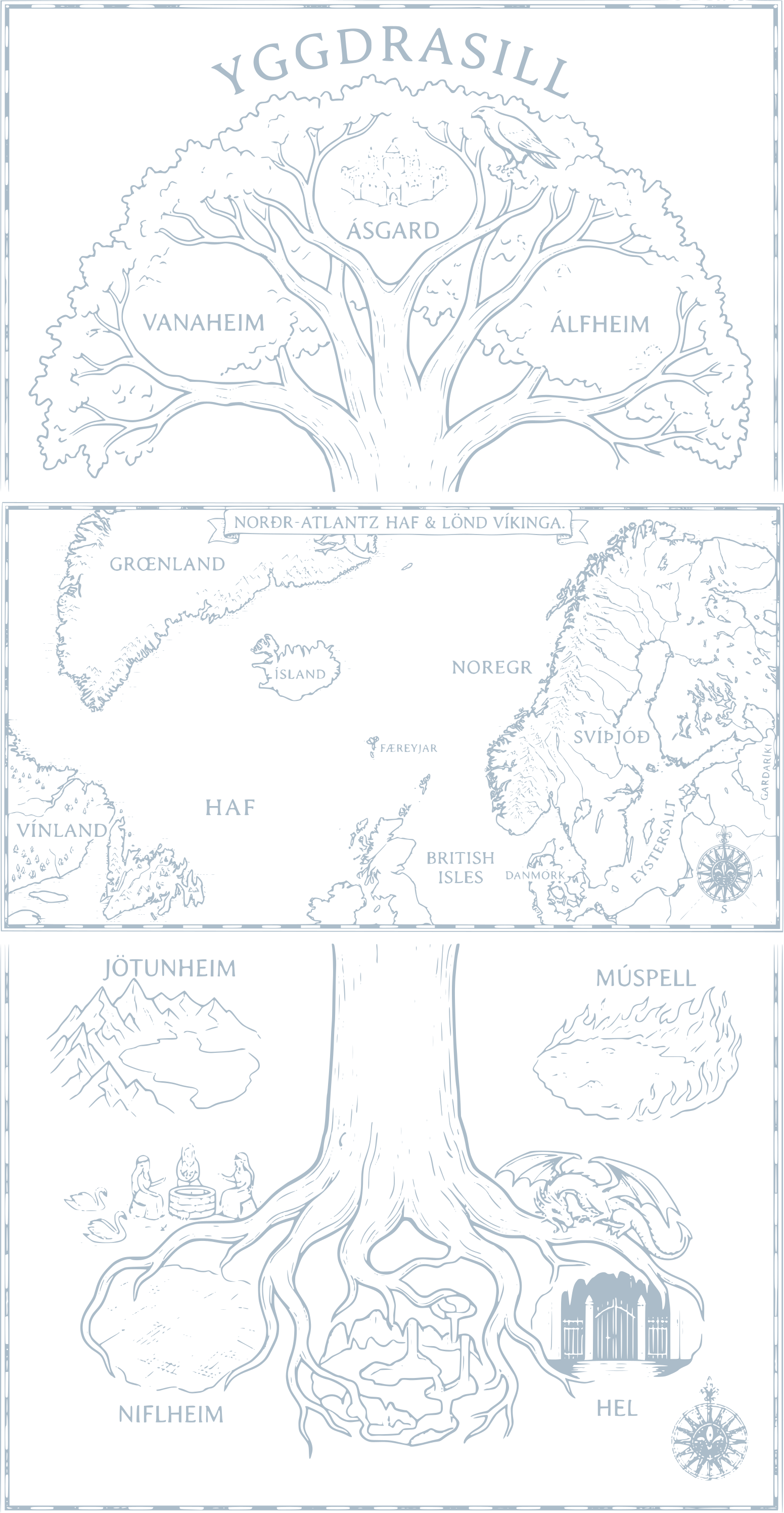
Hávamál ends by turning from human counsel to the god's own great mystery — how Odin won wisdom itself. In the poem's mythic crown, the High One tells how he hung nine nights on the windy tree, Yggdrasil, wounded with a spear and 'given to Odin, myself to myself', taking neither bread nor drink, peering down into the depths — until at the last he seized the runes, shrieking, and fell back.[1] He took no bread and no horn in that ordeal;[2] the knowledge had to be suffered for.
It is one of the most extraordinary images in any mythology: the chief of the gods sacrificing himself to himself, in agony, to win the secret wisdom of the runes — writing, memory, magic. It tells you what this culture believed about knowledge: that the deepest wisdom is not given but wrested from suffering, that even a god must pay in pain for it. And it closes the circle of the whole poem — all the worldly counsel of guest-craft and friendship and moderation rests, at the last, on a god who hung wounded on the World-Tree so that wisdom could exist at all. The High One earned the right to give his sayings. With the runes won, the poem makes its end, hailing the speaker and the one who learns.
The source text · 3
I ween that I hung / on the windy tree, / Hung there for nights full nine; / With the spear I was wounded, / and offered I was / To Othin, myself to myself, / On the tree that none / may ever know / What root beneath it runs.— havamal
Odin hangs nine nights on the windy tree, given to himself, and takes up the runes (Bellows 1923).
None made me happy / with loaf or horn, / And there below I looked; / I took up the runes, / shrieking I took them, / And forthwith back I fell.— havamal
none made him happy with loaf or horn; shrieking he took the runes (Bellows 1923).
Now are Hor's words / spoken in the hall, / Kind for the kindred of men, / Cursed for the kindred of giants: / Hail to the speaker, / and to him who learns! / Profit be his who has them! / Hail to them who hearken!— havamal
Hor's words spoken in the hall; hail to the speaker and to him who learns (Bellows 1923).
4 connection questions mark the end of this journey — and earn its keepable artifact.
More journeys → Follow a thread →