The Gods & the Eddas
The Beguiling of Gylfi
A king goes to question the gods
The Prose Edda was written around 1220 by the Icelander Snorri Sturluson — chieftain, historian, poet — partly as a handbook so that poets would not forget the old myths the new Christian age was letting slip. Gylfaginning, 'the Beguiling of Gylfi', is its mythological heart, and Snorri gives it a clever frame: Gylfi, a king of Sweden, travels in disguise under the name Gangleri to the hall of the Æsir to learn the truth of the world, and questions three shadowy figures on their high seats.[1]
Their answers are the mythology — creation, the gods, the doom — drawn out question by question, the whole cosmos delivered as a dialogue. It is worth saying plainly what this is and is not: Snorri was a Christian writing of the old gods as ancestral lore and poetry, not worship, and he frames the whole vision as a 'beguiling', an illusion the Æsir work on Gylfi. The atlas treats it the same way the rest of the corpus is treated — as the tradition's own account of itself, flagged to Snorri's genuine text, neither preached nor mocked. This is the mythic root beneath every saga here: the world-story the feud-bound farmers of Iceland carried in their heads.
The source text · 1
King Gylfi ruled the land that men now call Sweden. It is told of him that he gave to a wandering woman, in return for her merry-making, a plow-land in his realm, as much as four oxen might turn up in a day and a night. But this woman was of the kin of the Æsir; she was named Gefjun. She took from the north, out of Jötunheim, four oxen which were the soils of a certain giant and, herself, and set them before the plow. And the plow cut so wide and so deep that it loosened up the land; and the oxen drew the land out into the sea and to the westward, and stopped in a certain sound. There Gefjun set the land, and gave it a name, calling it Selund. And from that time on, the spot whence the land had been torn up is water: it is now called the Lögr in Sweden; and bays lie in that lake even as the headlands in Selund. Thus says Bragi, the ancient skald: Gefjun drew from Gylfi gladly the wave-trove's freehold, Till from the running beasts sweat reeked, to Denmark's increase; The oxen bore, moreover, eight eyes, gleaming browlights, O'er the field's wide booty, and four heads in their plowing.— gylfaginning
King Gylfi sets out to question the Æsir (Brodeur 1916).
Ice, fire, and the body of a giant
The first thing the gods tell Gylfi is how the world was made — and the Norse creation is one of the strangest and grandest in any mythology. In the beginning was Ginnungagap, the yawning void; to its north lay freezing mist, to its south a region of fire, and where the rime of the one met the sparks of the other, the dripping ice quickened into life: the first being, the frost-giant Ymir.[1]
Then the first gods, Odin and his brothers, slew Ymir and built the world from his corpse — the earth made of his flesh, the mountains of his bones, the sea of his blood, the dome of the sky from his skull held up at four corners, the clouds from his brains. It is a cosmos literally constructed out of a murdered giant, violence and making fused at the very root of things. Out of this raw beginning come the ordered worlds, the dwarves bred in the earth like maggots, and the first man and woman shaped from two trees on the shore. The Norse world is born of ice, fire, and killing — and it never forgets it.
The source text · 1
Gangleri asked: "How were things wrought, ere the races were and the tribes of men increased?" Then said Hárr: "The streams called Ice-waves, those which were so long come from the fountain-heads that the yeasty venom upon them had hardened like the slag that runs out of the fire,—these then became ice; and when the ice halted and ceased to run, then it froze over above. But the drizzling rain that rose from the venom congealed to rime, and the rime increased, frost over frost, each over the other, even into Ginnungagap, the Yawning Void." Then spake Jafnhárr: "Ginnungagap, which faced toward the northern quarter, became filled with heaviness, and masses of ice and rime, and from within, drizzling rain and gusts; but the southern part of the Yawning Void was lighted by those sparks and glowing masses which flew out of Múspellheim." And Thridi said: "Just as cold arose out of Niflheim, and all terrible things, so also all that looked toward Múspellheim became hot and glowing; but Ginnungagap was as mild as windless air, and when the breath of heat met the rime, so that it melted and dripped, life was quickened from the yeast-drops, by the power of that which sent the heat, and became a man's form. And that man is named Ymir, but the Rime-Giants call him Aurgelimir; and thence are come the races of the Rime-Giants, as it says in Völuspá the Less: All the witches spring from Witolf, All the warlocks are of Willharm, And the spell-singers spring from Swarthead; All the ogres of Ymir come.— gylfaginning
The Ice-waves, Ginnungagap, and the rise of Ymir (Brodeur 1916).
The World-Ash
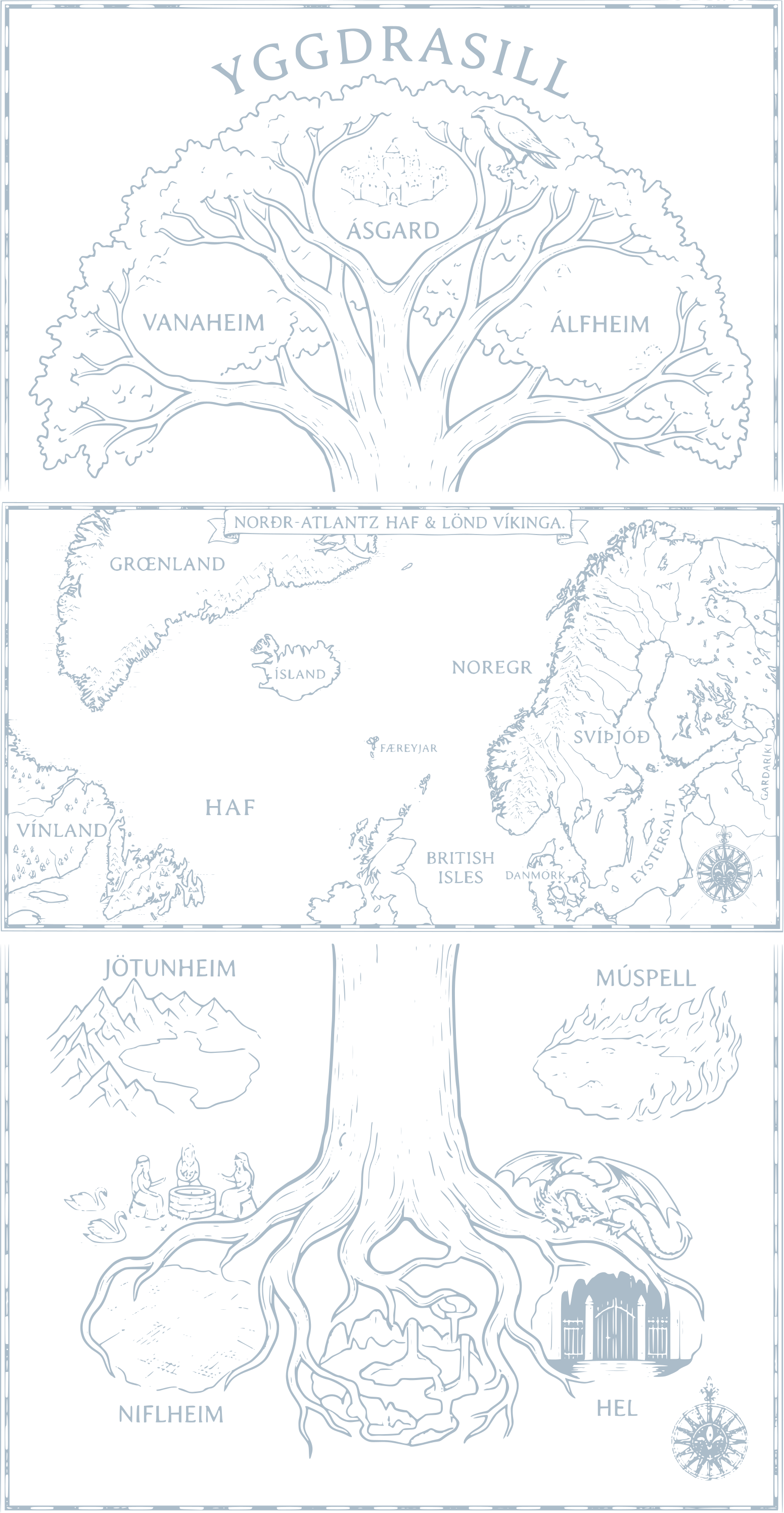
At the centre of everything stands Yggdrasil, the great Ash — the World-Tree whose limbs spread over all the worlds and whose three roots reach to three realms: to the Æsir, to the frost-giants, and to Hel below.[1] Beneath its roots lie the sacred wells, and at one of them sit the Norns, the three maidens who shape the destinies of men and gods alike — for in this mythology even the gods are subject to fate.[2]
The Ash is the axis that holds the cosmos together, and the gods cross to it daily over the rainbow bridge Bifröst to hold their councils. But it is a living thing under constant assault — a serpent gnaws its root, a hart bites its leaves, and it suffers more than men know. That image is the whole Norse vision in miniature: the ordered world is a tree, alive and beautiful and central, and it is always being eaten from below. Nothing here is eternal, not even the structure of the universe — and the gods know it.
The source text · 2
Then said Gangleri: "Where is the chief abode or holy place of the gods?" Hárr answered: 'That is at the Ash of Yggdrasill; there the gods must give judgment everyday." Then Gangleri asked: "What is to be said concerning that place?" Then said Jafnhárr: "The Ash is greatest of all trees and best: its limbs spread out over all the world and stand above heaven. Three roots of the tree uphold it and stand exceeding broad: one is among the Æsir; another among the Rime-Giants, in that place where aforetime was the Yawning Void; the third stands over Niflheim, and under that root is Hvergelmir, and Nídhöggr gnaws the root from below. But under that root which turns toward the Rime-Giants is Mímir's Well, wherein wisdom and understanding are stored; and he is called Mímir, who keeps the well. He is full of ancient lore, since he drinks of the well from the Gjallar-Horn. Thither came Allfather and craved one drink of the well; but he got it not until he had laid his eye in pledge. So says Völuspá: All know I, Odin, where the eye thou hiddest, In the wide-renowned well of Mímir; Mímir drinks mead every morning From Valfather's wage. Wit ye yet, or what?— gylfaginning
Yggdrasil the Ash, holy place of the gods, its three roots (Brodeur 1916).
Then said Gangleri: "If the Norns determine the weirds of men, then they apportion exceeding unevenly, seeing that some have a pleasant and luxurious life, but others have little worldly goods or fame; some have long life, others short." Hárr said: "Good norns and of honorable race appoint good life; but those men that suffer evil fortunes are governed by evil norns."— gylfaginning
the Norns who determine the weirds of gods and men (Brodeur 1916).
The trickster among the gods
The gods Gylfi hears of are vivid and flawed. Odin the Allfather rules them, one-eyed, having given an eye for a draught of wisdom — the same one-eyed wanderer who, in Sigurd's saga, strides into the hall to thrust a sword into the Branstock for the Völsungs and later shatters that sword in battle, the god reaching down into the legends of men. Thor, his son, strongest of all, defends gods and men against the giants with his hammer. But the most dangerous of the Æsir is one of their own: Loki, clever and beautiful and treacherous, giant-born, counted among the gods yet forever working against them.[1]
Loki is the engine of much of the mythology — sometimes the gods' rescuer by his wits, sometimes the author of their troubles, always ambiguous. The saga-world's fascination with the clever survivor who works by guile rather than honour — Þrándr of the Faroes, Snorri the Priest — has its divine archetype here. Loki is mind unmoored from loyalty, and the gods keep him close because he is useful, right up until the day his cleverness turns to malice and he engineers the one death they cannot bear. In a pantheon doomed to fall, it is fitting that the agent of the fall sits at the gods' own table.
The source text · 1
Then said Gangleri: "Great in power do these Æsir seem to me; nor is it a marvel, that much authority attends you who are said to possess understanding of the gods, and know which one men should call on for what boon soever. Or are the gods yet more?" Hárr said: "Yet remains that one of the Æsir who is called Týr: he is most daring, and best in stoutness of heart, and he has much authority over victory in battle; it is good for men of valor to invoke him. It is a proverb, that he is Týr-valiant, who surpasses other men and does not waver. He is wise, so that it is also said, that he that is wisest is Týr-prudent. This is one token of his daring: when the Æsir enticed Fenris-Wolf to take upon him the fetter Gleipnir, the wolf did not believe them, that they would loose him, until they laid Týr's hand into his mouth as a pledge. But when the Æsir would not loose him, then he bit off the hand at the place now called 'the wolf's joint;' and Týr is one-handed, and is not called a reconciler of men.— gylfaginning
The Æsir and their powers; Loki among them (Brodeur 1916).
The death of Baldr
The turning-point of the whole mythology is a death. Baldr, the fairest and best-loved of the gods, is troubled by dreams of his own doom, so his mother Frigg takes an oath from all things — fire, water, iron, beasts, sickness — never to harm him. Only the mistletoe is passed over, thought too young and slight to swear.[1] Secure, the gods make sport of Baldr's invulnerability, hurling weapons that will not bite.
But Loki learns of the mistletoe, fashions a dart of it, and puts it in the hand of the blind god Höðr, Baldr's brother, guiding his aim — and Baldr falls dead.[2] The grief is beyond words; the gods stand stricken and helpless.[3] They send a messenger riding nine nights down to Hel to beg Baldr back, and Hel will yield him only if every single thing in the world weeps for him — but one giantess (Loki in disguise) refuses, and Baldr must stay among the dead. With Baldr's death and failed ransom, the bright thing at the heart of the gods' world is lost, and the long slide to Ragnarök has begun. It is the saddest story the North told.
The source text · 3
"But when Loki Laufeyarson saw this, it pleased him ill that Baldr took no hurt. He went to Fensalir to Frigg, and made himself into the likeness of a woman. Then Frigg asked if that woman knew what the Æsir did at the Thing. She said that all were shooting at Baldr, and moreover, that he took no hurt. Then said Frigg: 'Neither weapons nor trees may hurt Baldr: I have taken oaths of them all.' Then the woman asked: 'Have all things taken oaths to spare Baldr?' and Frigg answered: 'There grows a tree-sprout alone westward of Valhall: it is called Mistletoe; I thought it too young to ask the oath of.' Then straightway the woman turned away; but Loki took Mistletoe and pulled it up and went to the Thing.— gylfaginning
Loki learns of the mistletoe, the one thing unsworn (Brodeur 1916).
"Hödr stood outside the ring of men, because he was blind. Then spake Loki to him: 'Why dost thou not shoot at Baldr?' He answered: 'Because I see not where Baldr is; and for this also, that I am weaponless.' Then said Loki: 'Do thou also after the manner of other men, and show Baldr honor as the other men do. I will direct thee where he stands; shoot at him with this wand.' Hödr took Mistletoe and shot at Baldr, being guided by Loki: the shaft flew through Baldr, and he fell dead to the earth; and that was the greatest mischance that has ever befallen among gods and men.— gylfaginning
Loki guides blind Höðr's hand with the mistletoe dart (Brodeur 1916).
"Then, when Baldr was fallen, words failed all the Æsir, and their hands likewise to lay hold of him; each looked at the other, and all were of one mind as to him who had wrought the work, but none might take vengeance, so great a sanctuary was in that place. But when the Æsir tried to speak, then it befell first that weeping broke out, so that none might speak to the others with words concerning his grief. But Odin bore that misfortune by so much the worst, as he had most perception of how great harm and loss for the Æsir were in the death of Baldr.— gylfaginning
Baldr fallen; the Æsir stricken speechless (Brodeur 1916).
Ragnarök, and the green world after
At last Gylfi asks the question the whole telling has been moving toward: how does it end? And the gods answer with Ragnarök, the Weird of the Gods — a vision unique in the mythologies of the world, for here the gods themselves are doomed and know it.[1] A great winter comes; the bound monsters break loose; the Wolf swallows the sun, the Midgard-Serpent rises from the sea, Loki and the giants sail against the gods, and on the last field gods and monsters destroy one another — Odin devoured by the Wolf, Thor and the Serpent slaying each other — while Surtr's fire burns the world and the earth sinks into the sea.
And yet it is not the end. The gods told Gylfi that a green earth rises again from the water, a few gods survive, two humans hidden in a wood live to repeople the world, and Baldr returns from the dead into the new age.[2] Then Gylfi's vision simply ends — the great hall vanishes, and he stands alone on an empty plain, the gods and their telling gone like smoke.[3] This is the keystone of the whole atlas: the doomed-but-defiant vision that lies beneath the sagas' fatalism. The Norse hero meets his death well because his gods do — the whole cosmos faces its certain doom with open eyes, and the only victory is to meet it bravely. Every ørlǫg, every fey man walking knowingly to his death in the family sagas, is an echo of Ragnarök.
The source text · 3
Then shall happen what seems great tidings: the Wolf shall swallow the sun; and this shall seem to men a great harm. Then the other wolf shall seize the moon, and he also shall work great ruin; the stars shall vanish from the heavens. Then shall come to pass these tidings also: all the earth shall tremble so, and the crags, that trees shall be torn up from the earth, and the crags fall to ruin; and all fetters and bonds shall be broken and rent. Then shall Fenris-Wolf get loose; then the sea shall gush forth upon the land, because the Midgard Serpent stirs in giant wrath and advances up onto the land. Then that too shall happen, that Naglfar shall be loosened, the ship which is so named. (It is made of dead men's nails; wherefore a warning is desirable, that if a man die with unshorn nails, that man adds much material to the ship Naglfar, which gods and men were fain to have finished late.) Yet in this sea-flood Naglfar shall float. Hrymr is the name of the giant who steers Naglfar. Fenris-Wolf shall advance with gaping mouth, and his lower jaw shall be against the earth, but the upper against heaven,—he would gape yet more if there were room for it; fires blaze from his eyes and nostrils. The Midgard Serpent shall blow venom so that he shall sprinkle all the air and water; and he is very terrible, and shall be on one side of the Wolf. In this din shall the heaven be cloven, and the Sons of Múspell ride thence: Surtr shall ride first, and both before him and after him burning fire; his sword is exceeding good: from it radiance shines brighter than from the sun; when they ride over Bifröst, then the bridge shall break, as has been told before. The Sons of Múspell shall go forth to that field which is called Vígrídr, thither shall come Fenris-Wolf also and the Midgard Serpent; then Loki and Hrymr shall come there also, and with him all the Rime-Giants. All the champions of Hel follow Loki; and the Sons of Múspell shall have a company by themselves, and it shall be very bright. The field Vígrídr is a hundred leagues wide each way.— gylfaginning
The Wolf shall swallow the sun; the doom of the gods (Brodeur 1916).
In the place called Hoddmímir's Holt there shall lie hidden during the Fire of Surtr two of mankind, who are called thus: Líf and Lífthrasir, and for food they shall have the morning-dews. From these folk shall come so numerous an offspring that all the world shall be peopled, even as is said here:— gylfaginning
The green earth rises again; the remnant of mankind and gods (Brodeur 1916).
Thereupon Gangleri heard great noises on every side of him; and then, when he had looked about him more, lo, he stood out of doors on a level plain, and saw no hall there and no castle. Then he went his way forth and came home into his kingdom, and told those tidings which he had seen and heard; and after him each man told these tales to the other.— gylfaginning
The hall vanishes; Gylfi stands alone — the vision ends (Brodeur 1916).
4 connection questions mark the end of this journey — and earn its keepable artifact.
More journeys → Follow a thread →